Post-Mortems That Don't Kill Trust
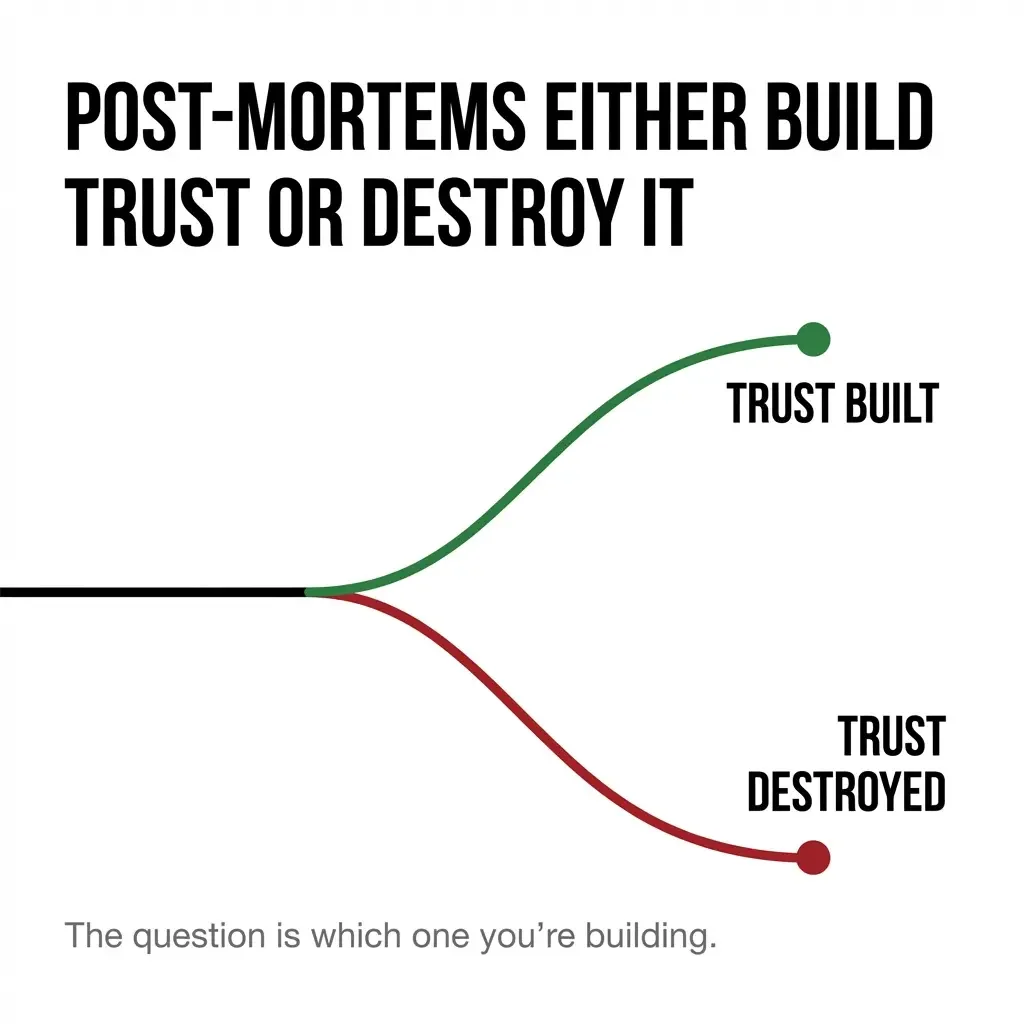
Post-mortems are supposed to help teams learn from failure. Most of them do the opposite. They erode the psychological safety they're meant to protect. I've watched teams go quiet in retrospectives. Not because they don't have insights. Because they don't trust what happens when they share them.
When post-mortem conversations go quiet, trust has already eroded. People stop talking when they fear the consequences of honesty. If there's a chance of losing a job or getting blamed, the incentive is to stay silent and keep mistakes hidden. This creates a dangerous cycle. Incidents get buried. Problems compound. The next failure becomes inevitable. The retrospective meeting isn't the time to create safety. The retro relies on trust as the status quo. If you don't have it before you walk into the room, you won't build it during the meeting.
Blame Is Hardwired
Blame is a way to discharge pain and discomfort. It's hardwired through millions of years of evolutionary neurobiology. When something goes wrong, our brains look for someone to hold responsible. Organizations that follow the old view of human error find the careless individual and reprimand them. This creates the unintended effect of disincentivizing the knowledge sharing required to prevent future failure. Engineers hesitate to speak up for fear of being blamed. This increases mean time to acknowledge, mean time to resolve, and makes incidents worse.
Blame creeps in through subtle language cues. When you say "Engineer X deployed faulty code," you're focusing on the person. When you say "The deployment included code that had not been tested against legacy batch scenarios," you're focusing on the process. This shift from person to system is the difference between defensive silence and honest learning. The most effective post-mortems ask "what" questions. What did you think was happening? What conditions were present? They avoid "why" questions. Why sounds accusatory. It creates defensiveness even when you don't intend it.
What Psychological Safety Actually Looks Like
People think psychological safety is just being nice to each other. Real psychological safety is when a team trusts each other enough to call each other out. Even in semi-formal meetings. I've seen teams agree on acceptance criteria in tickets but not follow through. Nobody called it out. I had to step in as the manager and address it. That's a sign the team doesn't have enough psychological safety to hold each other accountable in a retro. Psychological safety isn't about comfort. It's about trust that allows for honest feedback without fear of punishment. Google's Project Aristotle studied 180+ teams and found that psychological safety was the strongest predictor of team effectiveness. More than individual talent. More than technical skills. Teams with psychological safety admitted mistakes and learned from them. This led to increased productivity and job satisfaction.
Atlassian experienced a major outage caused by an engineer's configuration file mistake. Instead of shaming the engineer, they conducted a blameless post-mortem. They asked "How do we make it less possible for human error to happen?" The permanent fix was an automated check on the config file. Eventually they removed all human interaction with the system's configuration. The engineer involved still works at Atlassian and adds value to the team. This demonstrates that relational investment and system improvement aren't competing priorities. They're mutually reinforcing.
Blameless Doesn't Mean No Accountability
There's a common misconception that blameless culture means letting people off the hook. Accountability shifts from punishment to responsible ownership. In a healthy culture, accountability means taking initiative to fix issues, reporting problems early, and implementing changes. It's not about dodging consequences. It's about ensuring the focus is on prevention and transparency, not fear. Removing the fear of consequences frees people up to be honest about their mistakes. That's the only way to fix them.
Some teams are blameless toward junior engineers but not senior ones. "He should have known better" only gets applied to staff engineers and principal engineers. This creates unequal psychological safety. It prevents learning from senior engineer mistakes, which are often the most valuable learning opportunities because they reveal gaps in expert judgment. Blameless culture must apply uniformly across all seniority levels. Otherwise it becomes a performance that protects some while punishing others.
How to Actually Run a Blameless Post-Mortem
Start with the right framing. The goal is to understand what happened and prevent it from happening again. Not to find who's responsible.
Use system-focused language. Describe conditions, not people. Talk about what the deployment process allowed, not what the engineer did wrong.
Ask "what" and "how" questions. What did you observe? How did the system behave? What information was available at the time?
Avoid "why" questions. They sound accusatory even when you don't mean them that way.
Document without blame. Write the post-mortem in a way that focuses on system gaps, not individual actions.
Follow up with system changes. The post-mortem isn't complete until you've implemented changes that make the failure less likely to recur.
The Real Test
You know your post-mortem process works when people volunteer information about their mistakes. When someone says "I think I caused this" without fear, you've built real psychological safety. When the team focuses on fixing the system instead of finding fault, you've created a learning culture. When the person who made the mistake is still on your team six months later and contributing value, you've proven that care and accountability can coexist. Post-mortems either build trust or destroy it. There's no neutral ground.
The question is which one you're building.